SectorPulse - An AI-Native 0→1 Product Case Study
Founder · Product Designer
AI-Native 0→1 SaaS Product
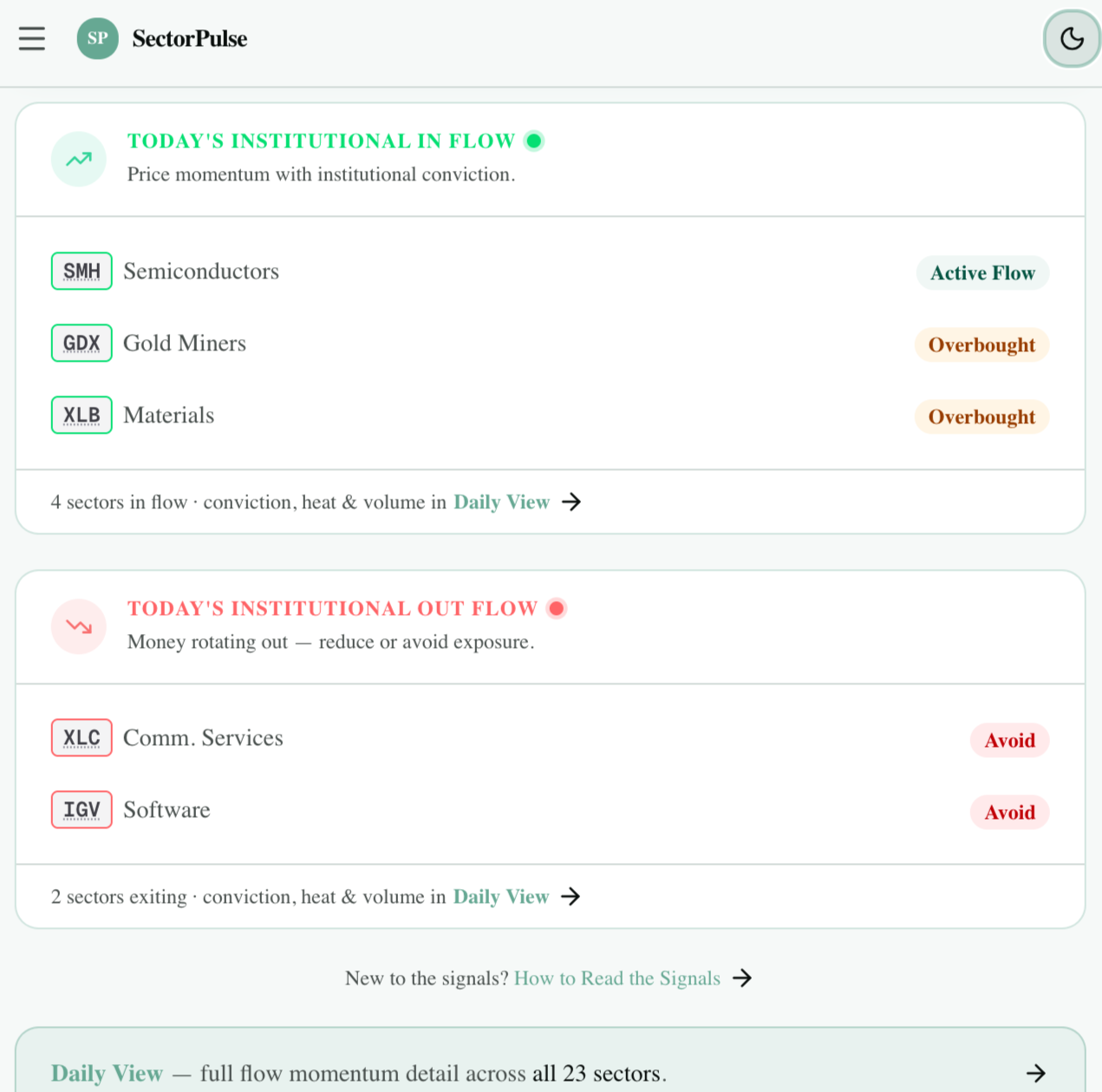
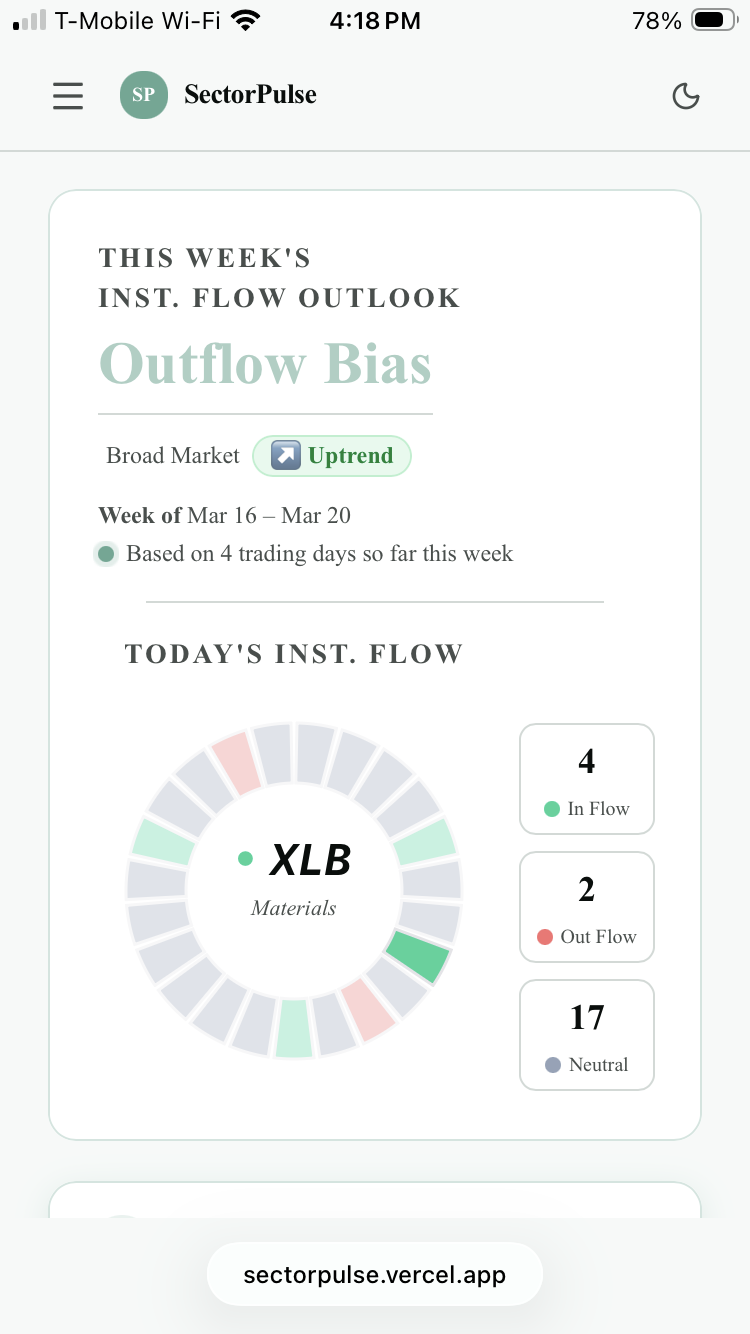
SectorPulse is a SaaS sector rotation signal tracker built for retail investors who follow institutional money flow as a directional guide for their portfolio decisions. The platform monitors 23 sector ETFs daily, translating price, volume, and momentum data into clear, math-based signals that identify where institutional capital is rotating in and where it is rotating out. Signals are delivered once a day, after market close, with no analyst opinion or subjective commentary attached.
The project is a deliberate experiment in AI-native product development, using N8N as a workflow sandbox then Claude Code as an active collaborator across research and code, while keeping all product strategy and judgment human.
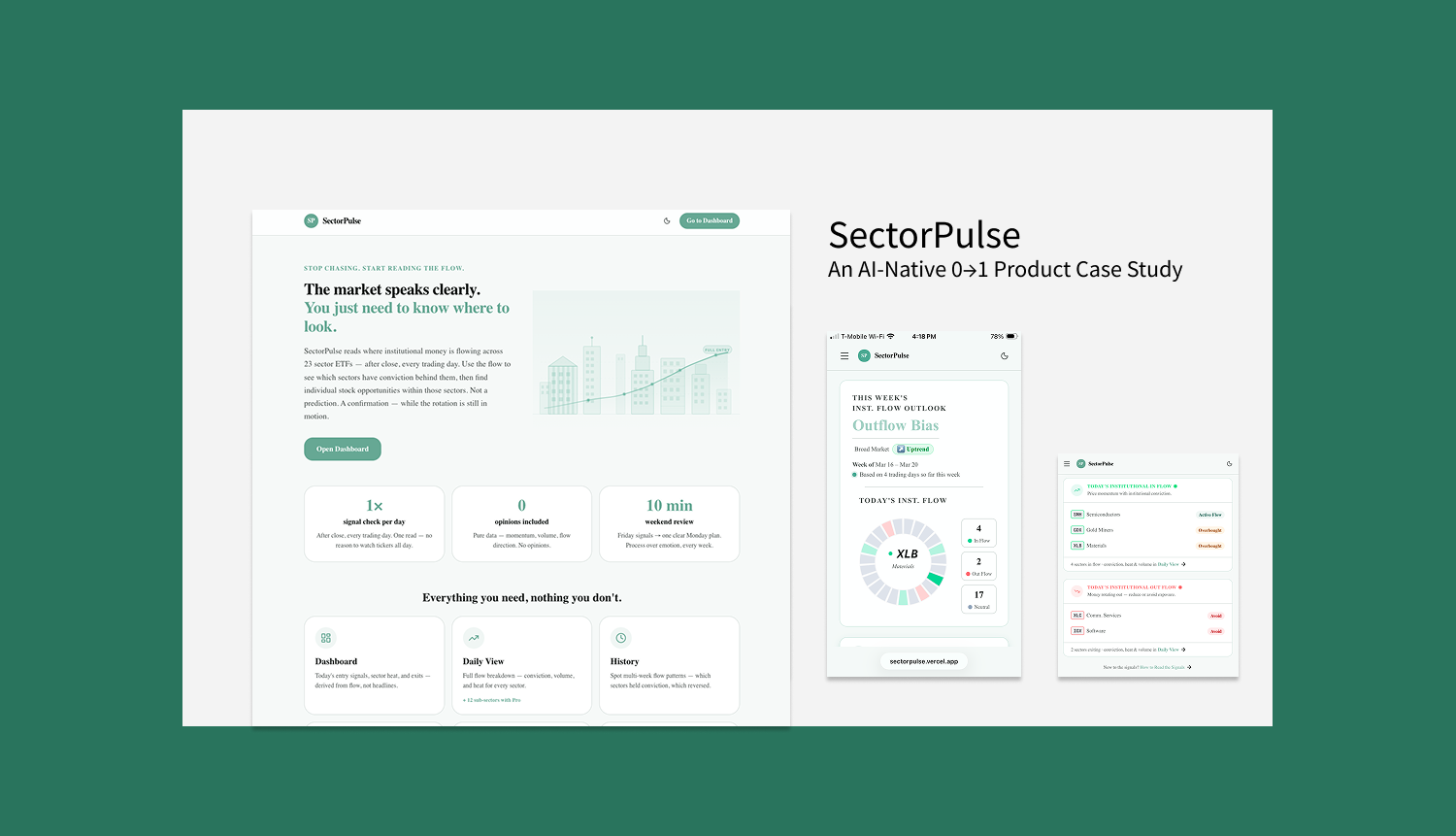
This is a full 0→1 product build, from initial user research and signal language design to a live, deployed product with an automated daily data pipeline.
The Challenge:
Retail investors who follow institutional money rotation face a paradox: the information they need exists, but it arrives buried under hours of noise. Financial media, social feeds, and analyst opinion cycle faster than any signal can be validated. For a certain type of trader, methodical, process-driven, and deeply skeptical of opinions, this creates a specific kind of exhaustion. Not from lack of information. From too much of the wrong kind.
The opportunity wasn't to build another dashboard with more data. It was to answer a single question clearly, once a day, after the market closed: where is institutional money actually flowing right now?
SectorPulse is the answer to that question: a sector rotation signal tracker built for what I came to call The Noise Avoider, a retail trader who wants one daily read, math-based signals with zero analyst opinion, and a repeatable weekly process that removes emotion from the decision.
UX Approach: Starting with the User
Before designing anything, I needed to validate that this user actually existed in meaningful numbers and understand how they thought and talked about the problem. Using AI as a research collaborator, I conducted a community listening study across Reddit (r/stocks, r/ETFs, r/options), X/Twitter discussions around institutional flow, and trading
forums where sector rotation is actively discussed. The goal wasn't to count posts. It was to extract the authentic language, pain points, and mental models of this specific users.
Three patterns emerged consistently.
Chasing late is the universal frustration: investors understood that sector rotation is like musical chairs, and visible entry points often arrive after the opportunity has passed. The gap between knowing and doing was just as common; users described having rules they didn't follow and systems they abandoned mid-week when the market moved against them.
And the language was clear: the community says "the flow", "rotating into", "institutional money moving". Not "model" or "algorithm." This research directly shaped every line of copy in the product: signal names, landing page headlines, and in-app explanations all use the community's own language back at them.
Designing the Signal Language
One of the most consequential design decisions in the project had nothing to do with visual design. It was about language.
Early builds used the phrase "the SectorPulse model" to describe the signal calculation logic. Through community research, it became clear this framing created the wrong mental model. "Model" suggests a complex algorithmic black box that positions the product as something to be trusted blindly rather than understood. For a user who is deeply skeptical of analyst opinion, handing their judgment over to "a model" felt like the same problem they were trying to escape.
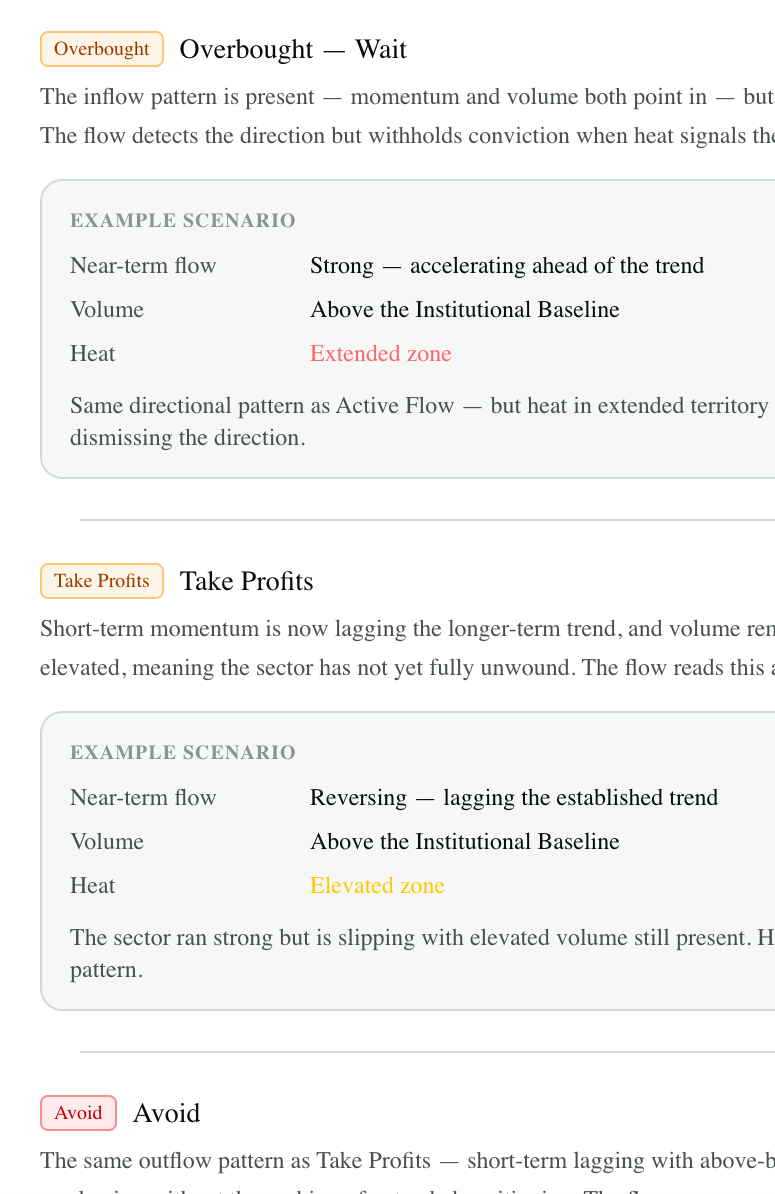
Replacing "the model" with "the flow" throughout the entire product changed the tone from "trust our algorithm" to "here's what the data is showing." This extended to the signal names themselves: Active Flow, Capital Defense, Sustained Flow. Each one frames signals as observations about institutional movement, never as directives.
WCAG Compliance as a Design Constraint
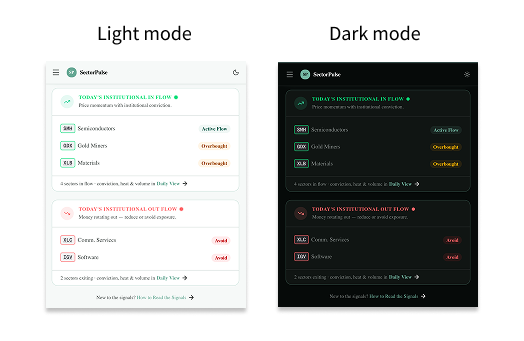
Throughout the build, every component carrying signal information was evaluated against WCAG 2.0 AA contrast requirements, a constraint applied proactively rather than as an afterthought.
The signal badges use small text at 10–12px. At those sizes, the 4.5:1 contrast ratio requirement becomes a meaningful constraint on color choice. The sage green primary color required deliberate darkening in light mode to pass contrast testing.
Amber and red tones used for warning signals required similar treatment. The discipline of checking contrast at every iteration (not just at the end) kept the signal system legible across both light and dark modes without compromising the visual language.
AI-Native 0→1: From Concept to Live Product as a Solo Builder
SectorPulse is a deliberate experiment in AI-native product development — how far can one person take a product from zero to live, shipped software, and how fast?
The signal logic was first built and validated in N8N, an agentic automation tool, running against real market data. That pre-validated workflow became the spec. When the build moved to Claude Code, there was no ambiguity to resolve — the logic was already proven. The result: a compressed development cycle that covered research, design, copy, code, and deployment, all within a single collaboration.
"Design decisions happen in conversation, get implemented immediately, and deploy to a live URL within minutes."
Claude served as research partner, design reviewer, and implementation layer. It synthesized community research, flagged contrast failures, challenged copy decisions against user data, and translated validated logic into working code. All product judgment remained human — who the user is, what problem to solve, what language earns trust. AI amplified the clarity already there. It did not supply it.
Where It Stands
SectorPulse is live and tracking 23 sector ETFs across daily signal generation, dashboard, daily view, 30-day history, and the Weekend Plan. The pipeline runs automatically after market close every trading day.
Current development: Stripe integration (Pro subscription), Friday email digest via Resend, and a per-sector stock screener, the feature that closes the loop between sector signal and individual stock opportunity.
Visit the live site: https://sectorpulse.vercel.app/